Choosing the Right Communication
Meetings, Email, Chat Messaging
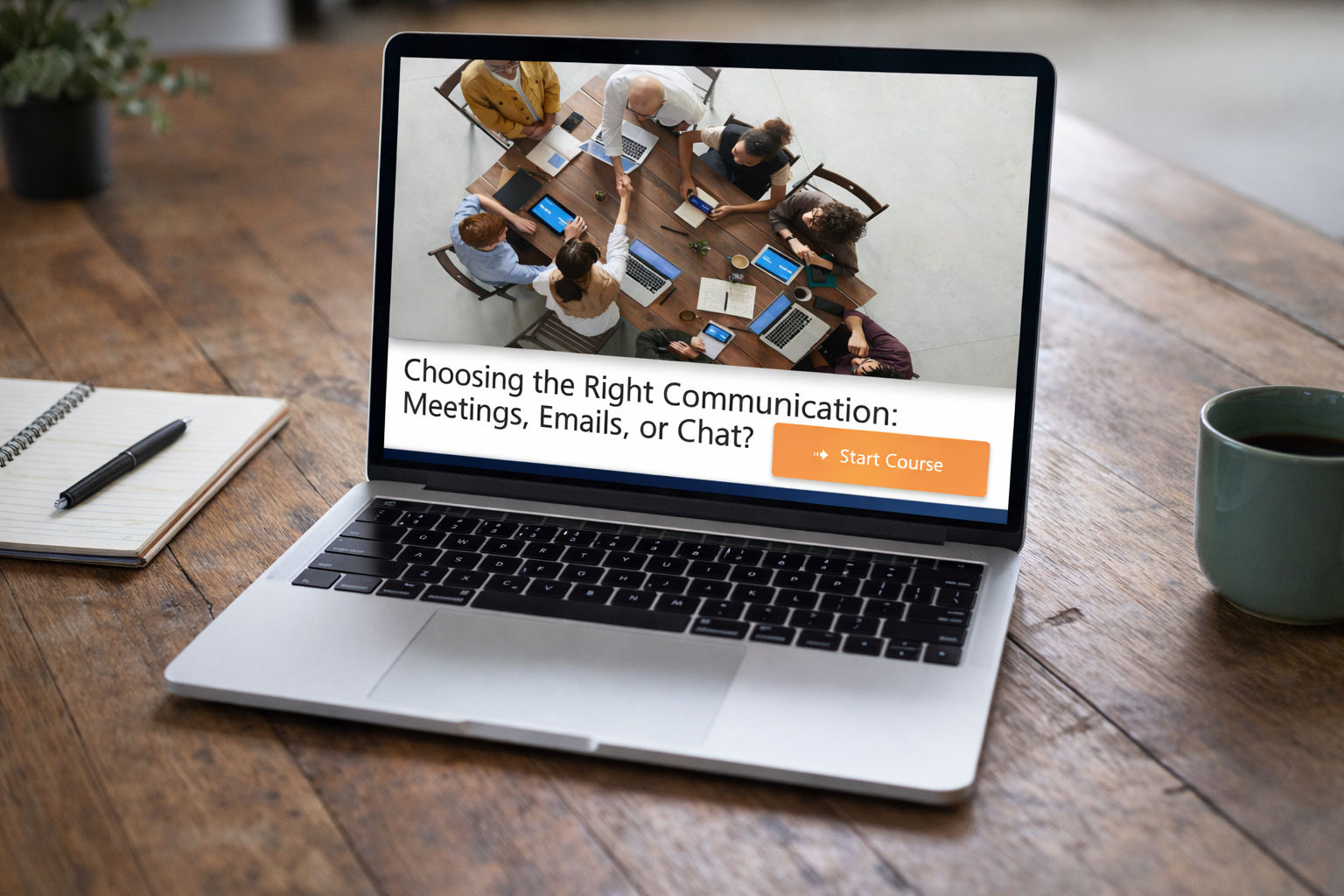
Audience: New and early-career professionals in hybrid or office-based teams who need to choose the most effective channel for everyday workplace communication.
Responsibility: Instructional Design, Action Mapping, Storyboarding, Script writing
Tools used: Articulate 360, ChatGPT
Problem
Teams can lose productive time when meetings are used for updates, questions, or decisions that could be handled asynchronously. In conversations with professionals across banking, healthcare, and utilities, I found that employees often needed clearer guidance for deciding when to use a meeting, email, or chat message. With that in mind, I developed a scenario-based learning approach to help people better understand the characteristics of different communication methods and practice choosing the most appropriate one for each situation.
Performance Gap
Learners need to evaluate purpose, urgency, complexity, documentation needs, audience size, and time sensitivity before selecting a communication channel.
Action Mapping
For this project, I collaborated with a business analyst, who served as my Subject Matter Expert (SME), to develop the action map and define a measurable goal. The goal we set was to drive productivity gains through intentional reductions in meetings and time optimization.
From there, the SME identified six key characteristics (purpose, urgency, complexity, documentation, audience size, and time sensitivity) to differentiate the communication methods and guide users in selecting the most appropriate one.
Final eLearning Experience
Using the feedback from the prototype, I moved into full development with a focus on creating an immersive and intuitive learning experience that would keep users engaged throughout. I incorporated animations to create smooth transitions between slides, giving the course a more fluid and interactive feel.
Every element—from layout to interactivity—was intentionally designed to help learners stay focused on the content without unnecessary distractions. Seeing all the pieces come together in the final product was especially rewarding.
Solution
I proposed a self-paced, scenario-based eLearning solution to help individuals choose the most appropriate communication method—whether meetings, email, or chat messaging—for the following reasons:
Flexibility: On-demand practice: A short, self-paced format lets busy employees practice communication choices without adding another meeting to their calendars.
Consistency: Shared decision framework: Each scenario applies the same six criteria, helping teams use more consistent reasoning when choosing a channel.
Scalability: Reusable onboarding resource: The module can support new hires and existing staff, while the scenario framework can be adapted for different teams or communication policies.
My Process
During analysis, I conducted informal interviews with three workplace professionals, a business analyst, an Epic ambulatory analyst, and a senior vice president of network infrastructure, to understand communication-channel challenges across different work contexts. Their insights informed the action map, scenario design, and decision factors. I also reviewed current research on meeting load and workplace communication to refine the project’s performance goal.
Visual Mockups
I tested and created mockups in Articulate 360 while exploring the full range of features it offers, allowing me to experiment with interactions, layouts, and functionality to enhance the overall learning experience.
I selected orange and blue as the primary colors—orange to convey energy, warmth, and a sense of action, and blue to represent trust and clarity. I chose red, purple, and green as accent colors in the graphic organizers because red represents excitement and energy, green reflects growth, and purple conveys creativity—qualities I want learners to associate with the information they are receiving.To support accessibility and readability, I tested multiple color combinations for text boxes and buttons before finalizing them in the style guide.
I also chose character vectors to allow for flexibility across different scenarios while maintaining a consistent visual style throughout the eLearning.
As I developed each slide and experimented with alignment, layout, colors, and element placement, the design process became more engaging, especially as the story gradually came to life.
Text-Based Storyboard
I developed a text-based storyboard as a blueprint for the project, designed to immerse the learner through storytelling and engaging scenarios. The narrative follows a workplace professional (the learner) who must decide when a meeting, email, or chat messaging is most effective throughout a busy workday.
Much like in real life, each communication choice has consequences. When the learner selects the most appropriate method, they see a positive outcome—such as improved efficiency or clearer collaboration—and move forward in the scenario.
If the learner chooses an ineffective communication method, they experience realistic setbacks, like delays or miscommunication.
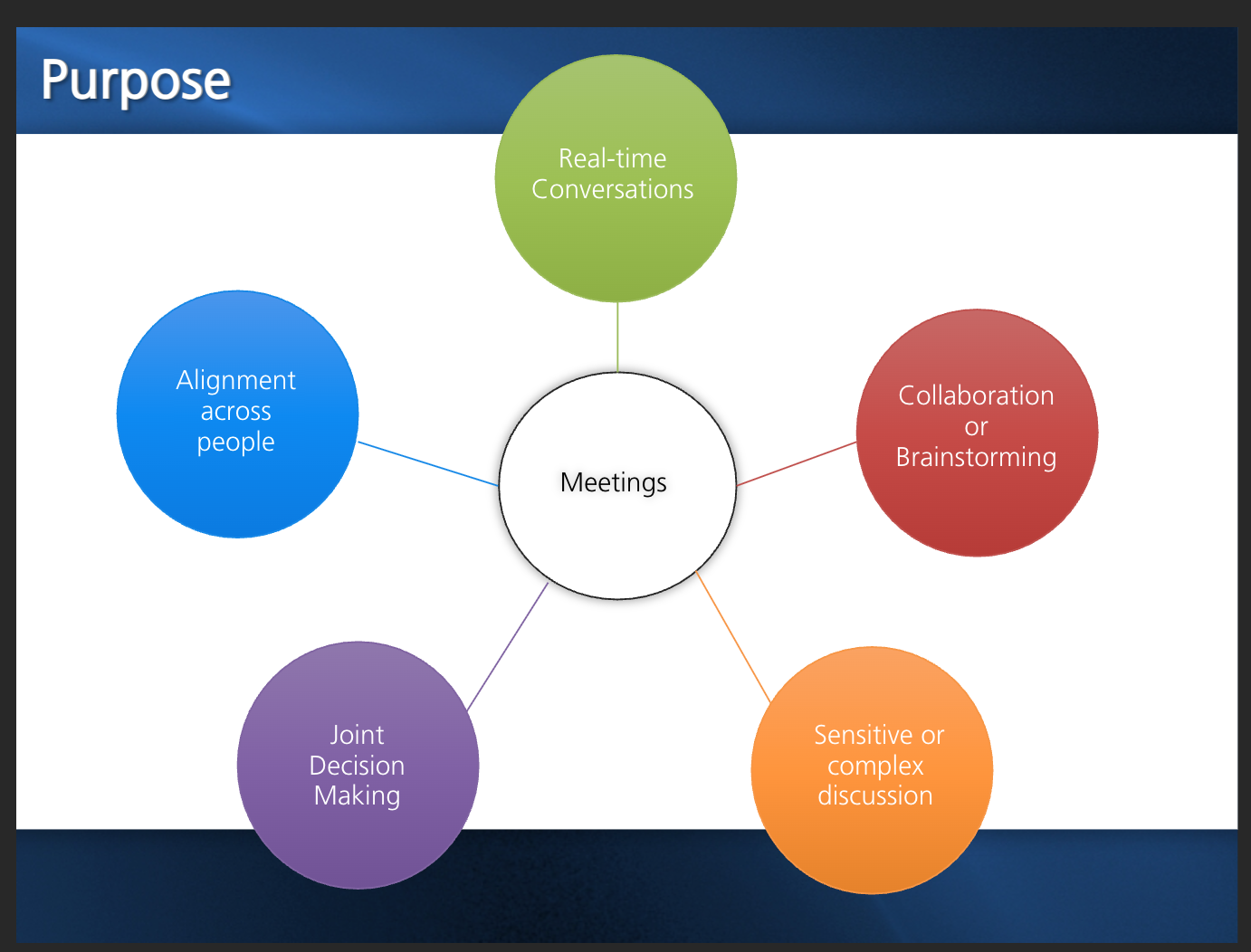
Overview
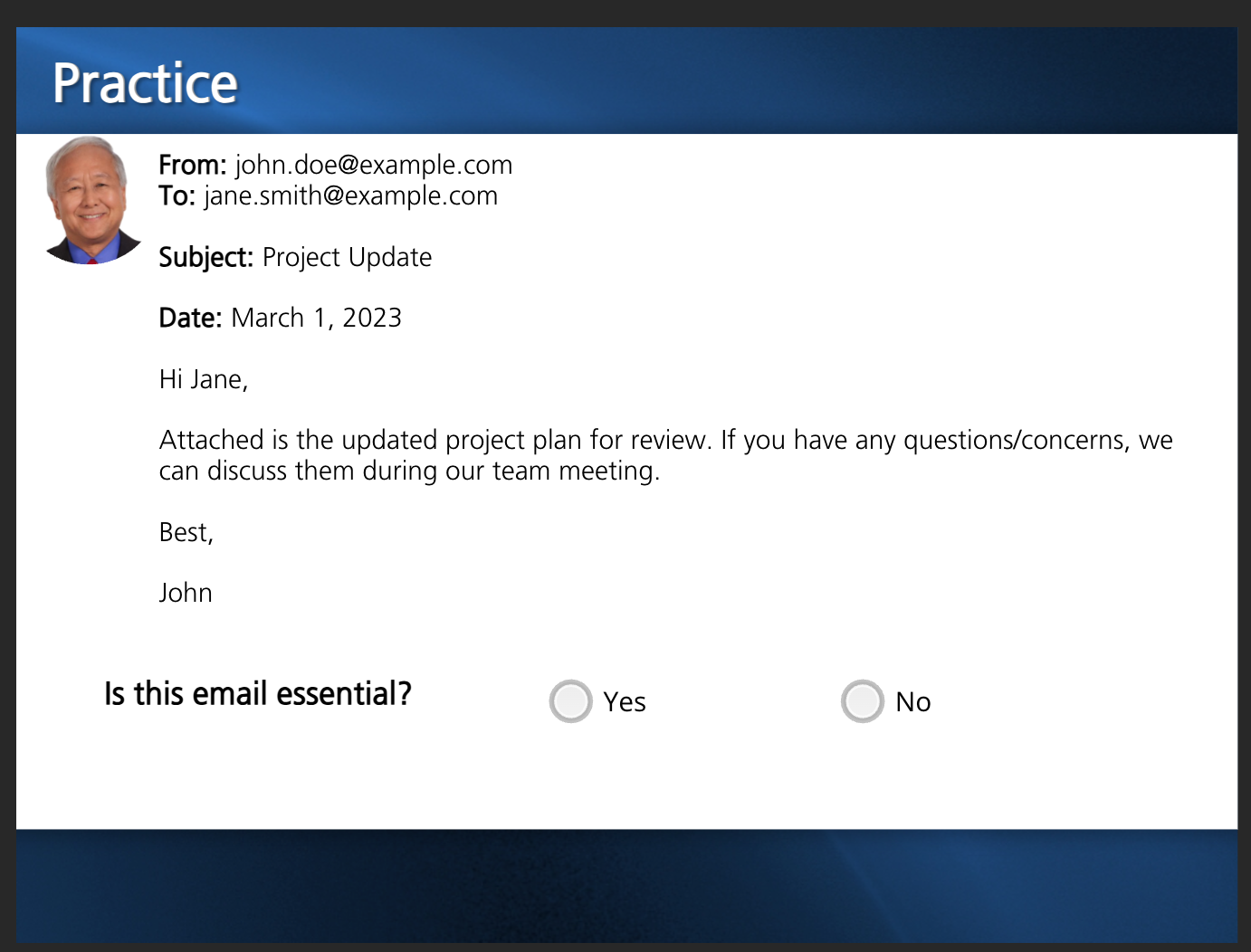
Email Scenario
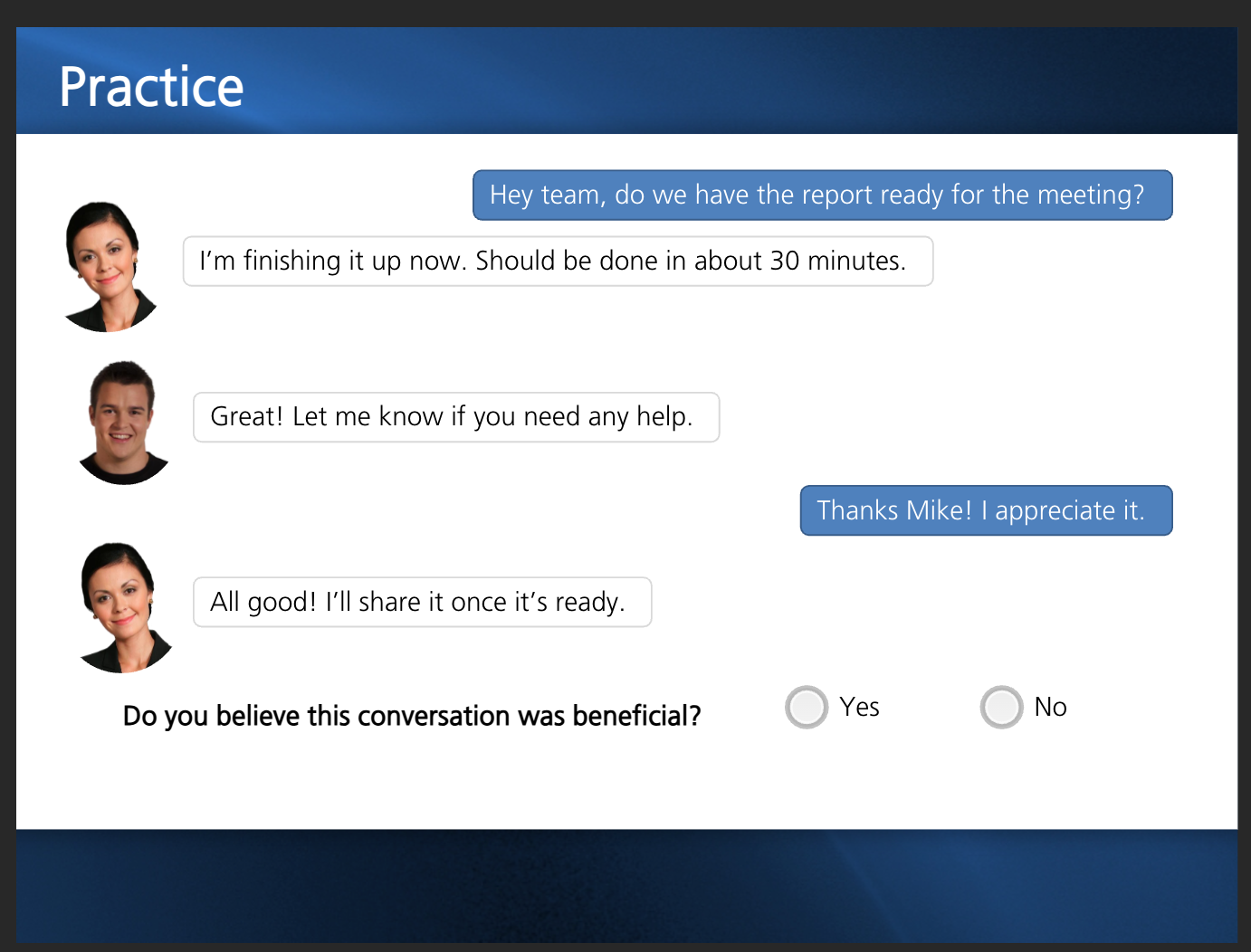
Chat Scenario
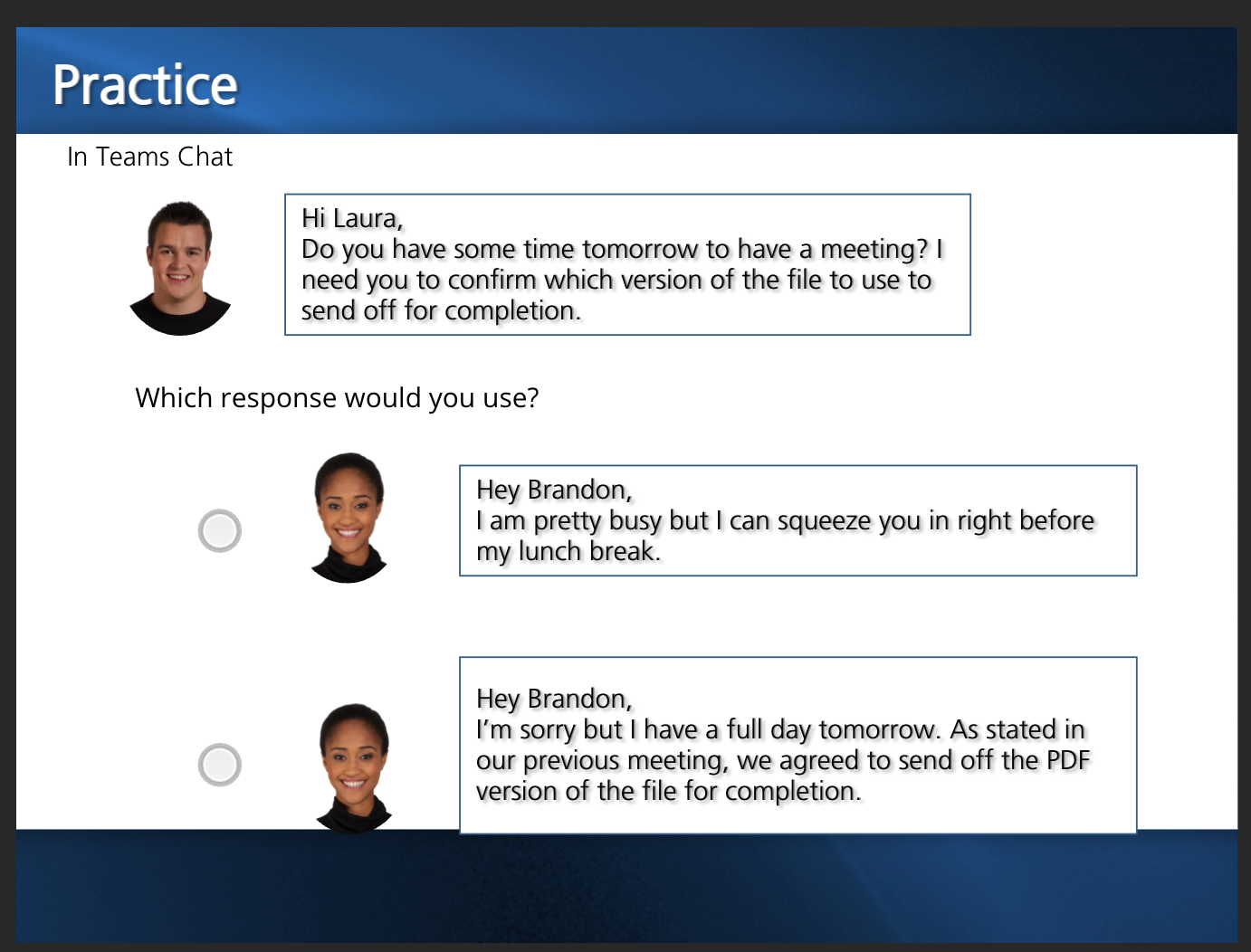
Chat Scenario
Interactive Prototype
After receiving feedback on the functionality, I finalized the product in Articulate Storyline 360. The prototype included the introduction of each communication method, a complete scenario with prompts for each communication method, question choices, and consequences.
During this development phase, I partnered with instructional designers and applied user testing feedback to optimize the learning experience and improve its overall flow.

Evaluation Plan and Reflection
Since this was a conceptual project, the process concluded at full development. However, in a real-world setting, I would evaluate its effectiveness using Kirkpatrick’s Model. This would include several key steps:
First, I would measure learner satisfaction through post-training surveys or feedback forms to understand their experience with the course on selecting the right communication method—meetings, email, or chat messaging.
Next, I would assess knowledge acquisition through quizzes or scenario-based assessments to ensure learners can accurately identify when to use each communication method.
Then, I would evaluate behavior change by observing how well learners apply these communication strategies in their daily work, such as reducing unnecessary meetings or choosing more efficient asynchronous options.
Finally, I would measure the overall impact on organizational performance by tracking relevant metrics, such as improved productivity, reduced meeting time, and more effective team communication aligned with the training goals.